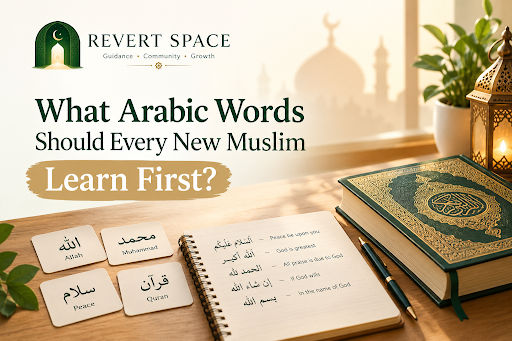
What Arabic Words Should Every New Muslim Learn First?
Stepping into Islam brings a whole new vocabulary along with it. Every prayer, greeting, and everyday conversation among Muslims carries words rooted in Arabic. Picking up a few essential Islamic phrases for beginners early on makes this transition feel natural instead of overwhelming.
You don’t need fluency to feel at home in your new community. You need a starting set of words that show up again and again, in the mosque, in group chats, and in daily life. Here’s where to begin.
Why These Words Matter From Day One
Arabic isn’t just a language in Islam, it’s the language of worship itself. The Quran was revealed in Arabic, the five daily prayers are recited in Arabic, and even casual greetings between Muslims carry Arabic phrasing. Without a basic grasp of these terms, a new revert can feel lost during gatherings or unsure how to respond when someone greets them.
Learning this vocabulary early does three things. It helps you follow prayer with understanding rather than memorized sound. It lets you communicate naturally with other Muslims. And it deepens your connection to the meaning behind the rituals you’re now practicing.
Words You’ll Hear During Salah
Prayer is usually the first place new Muslims encounter Arabic terminology in a structured way. A few core words appear in every single prayer:
- Takbir: saying “Allahu Akbar” (God is greatest) to begin and transition through prayer
- Fatiha: the opening chapter of the Quran, recited in every unit of prayer
- Ruku: the bowing position
- Sujood: the prostration position, forehead to the ground
- Tashahhud: the sitting recitation near the end of prayer
- Salam: the greeting of peace that closes the prayer
Knowing these words by meaning, not just by sound, turns prayer from a memorized routine into something you actually understand while performing it.
Everyday Phrases Muslims Use in Conversation
Outside of prayer, Muslims weave Arabic naturally into daily speech, even when speaking other languages. These are the phrases you’ll hear constantly:
- Assalamu Alaikum: “peace be upon you,” the standard greeting
- Wa Alaikum Assalam: the reply, “and peace be upon you too”
- InshaAllah: “if God wills,” used when talking about future plans
- MashaAllah: expressing admiration or gratitude for something good
- SubhanAllah: “glory be to God,” said in amazement or reflection
- Alhamdulillah: “all praise is due to God,” used constantly, even in casual replies to “how are you?”
- Astaghfirullah: “I seek forgiveness from God,” said after a mistake or something distressing
- Jazak Allah Khair: “may God reward you with good,” a common way to say thank you
Picking up these eight phrases alone will cover most of the everyday exchanges you’ll have within the Muslim community.
Core Belief Terms Every Revert Should Know
Beyond greetings and prayer, a handful of theological terms come up constantly in books, lectures, and conversations about faith:
- Tawheed: the oneness of God, the central concept in Islamic belief
- Iman: faith or belief
- Deen: often translated as “religion,” though it more broadly means a complete way of life
- Ummah: the global community of Muslims
- Sunnah: the practices and example of the Prophet Muhammad ﷺ
- Hadith: recorded sayings and actions of the Prophet ﷺ
New Muslims often hear Deen and Ummah used interchangeably with English equivalents, but understanding the fuller meaning behind each word adds real depth to how you understand your new faith.
Words Connected to the Quran
Since the Quran sits at the center of Islamic practice, a few terms related to it are worth learning early:
- Surah: a chapter of the Quran
- Ayah: a single verse
- Tafsir: scholarly explanation or interpretation of Quranic verses
- Tilawah: the recitation of the Quran
These words come up any time someone references a specific verse or recommends a book of interpretation, so having them in your vocabulary saves a lot of confusion.
Halal, Haram, and Daily Life Vocabulary
A few practical terms shape daily decisions for Muslims, from what to eat to how to prepare for prayer:
- Halal: permissible according to Islamic law
- Haram: forbidden
- Wudu: the ritual washing done before prayer
- Mustahabb: recommended, though not obligatory
- Makruh: discouraged, though not sinful
Did You Know? Many everyday English words actually have Arabic origins, including “sugar,” “coffee,” and “algebra.” Recognizing this connection can make learning Islamic vocabulary feel less foreign than it first appears.
Common Mistakes New Muslims Make With These Terms
- Using Arabic phrases without knowing their actual meaning, which can lead to saying something out of context
- Mixing up similar-sounding words, like Sunnah (practice) and Sunni (a branch of Islam)
- Feeling pressure to sound fluent immediately, which often causes people to avoid speaking these words at all
- Skipping the meaning of prayer terms and only memorizing the sounds phonetically
Based on working with reverts through their first year of practice, the ones who progress fastest are the ones who ask what a word means the moment they hear it, rather than nodding along and hoping it clicks later.
Pro Tips to Learn This Vocabulary Faster
- Keep a small notes app list of new words as you hear them, with a one-line meaning next to each
- Say the meaning out loud in English right after using the Arabic term, until it becomes automatic
- Attend a beginner-friendly class where terms are explained, not assumed
- Practice with another revert or a patient friend rather than only in formal settings
Revert Space’s beginner courses walk through this vocabulary alongside prayer and Quran basics, so you’re not trying to piece it together from scattered conversations.
In Short
New Muslims tend to pick up Arabic vocabulary fastest when they focus first on prayer terms, common greetings, and a handful of belief words, rather than trying to learn Arabic as a full language right away. Meaning comes before fluency, and understanding grows naturally with practice and community.
FAQ Section
Q1: Do I need to learn Arabic fluently as a new Muslim?
No. Fluency isn’t required to practice Islam correctly. A working vocabulary of prayer terms, greetings, and core belief words is enough to participate fully and grow from there.
Q2: What’s the very first Arabic phrase I should learn?
Assalamu Alaikum and its reply, Wa Alaikum Assalam, since you’ll use this greeting from your very first interaction with other Muslims.
Q3: How long does it take to memorize prayer-related Arabic words?
Most reverts pick up the core prayer vocabulary within a few weeks of consistent practice, especially when paired with understanding the meaning behind each word.
Q4: Is it okay to say these phrases in English instead?
Yes, meaning matters more than language. Saying “peace be upon you” instead of “Assalamu Alaikum” is fine, though learning the Arabic helps you connect with the wider Muslim community.
Q5: What’s the difference between Deen and Ummah?
Deen refers to the faith and way of life itself, while Ummah refers to the global community of people who follow that faith.
Q6: Where can new Muslims learn these words in a structured way?
Revert Space offers beginner-focused courses that introduce Islamic vocabulary alongside prayer, Quran reading, and foundational beliefs, so new Muslims aren’t learning in isolation.
Conclusion
You don’t need to master Arabic to feel confident as a new Muslim. Start with a few essential words and phrases, understand their meanings, and let your vocabulary grow naturally through prayer and daily life.
With beginner-friendly guidance from Revert Space, you can build your Arabic and Islamic knowledge step by step, making your journey feel simpler, clearer, and more meaningful.